Medical research has a problem that rarely makes headlines: the infrastructure behind it has not kept up with the scale of what researchers need to do.
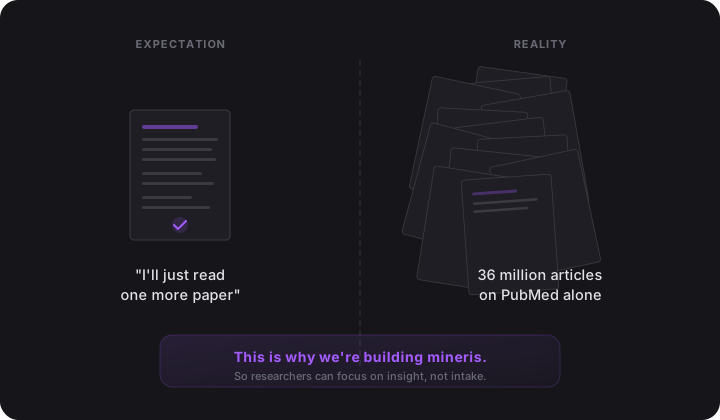
There are over 36 million articles in PubMed. Thousands more are published every day. A clinician trying to answer a single evidence question — say, whether a treatment is effective for a specific population — may need to sift through hundreds of papers, assess study quality, compare conflicting findings, and synthesize it all into something actionable. Most of the tools available to them were not built for this.
We started mineris because we believe this can be fundamentally better.
Improve the accuracy of medical research
Errors in evidence synthesis are not just academic — they affect treatment decisions, clinical guidelines, and patient outcomes. When a systematic review misses a relevant study or misjudges the quality of evidence, the downstream consequences are real.
We are building retrieval and ranking systems specifically tuned for biomedical literature. Not general-purpose search that happens to index PubMed, but purpose-built infrastructure that understands study design, population characteristics, and the structure of medical evidence. The goal is simple: when a researcher asks a question, the answer should be grounded, complete, and verifiable.
Let professionals focus on their work
Researchers did not train for years to become experts at keyword search and spreadsheet management. They trained to understand biology, evaluate evidence, and make decisions that improve health outcomes.
Too much of their time is spent on mechanical tasks — reformatting citations, manually screening titles, copying data between tools. We want to take that burden off their plate. Not by replacing their judgment, but by handling the parts of the workflow that do not require it.
When a researcher sits down with mineris, they should be able to spend their time thinking, not clicking.
Build advanced simulations of the human organism
This is the longer-term vision. As we improve how evidence is retrieved, structured, and connected, we are building toward something larger: computational models that can simulate aspects of human biology at a level useful for research and clinical decision-making.
This is not science fiction. It starts with better knowledge graphs, better representations of physiological relationships, and better integration of evidence across domains — pharmacology, genomics, clinical trials, epidemiology. Every piece of infrastructure we build now is a step toward that goal.
Help researchers get better at their work
We do not see mineris as a replacement for human expertise. We see it as a way to amplify it.
A junior researcher using mineris should be able to conduct a literature review that meets the rigor of a senior one. A clinician without a dedicated research team should be able to answer evidence questions with the same confidence as someone at a major academic center. The tools should raise the floor, not just serve the people already at the top.
Where our money goes
We are not building mineris to optimize for margins. Every dollar we earn goes back into the platform and into the broader mission: transitioning medical professionals to the next level of what is possible.
That means investing in better models, better data pipelines, and better interfaces. It means keeping the free tier meaningful and the paid tiers honest. And it means staying focused on the researchers and clinicians who actually use this — not on metrics that look good in a pitch deck.
What to expect from this blog
This is where we will share more about our research, how we operate as a team, and what we are working on. Expect posts on retrieval methods, evidence synthesis pipelines, engineering decisions, and the problems we are solving along the way.
There is a lot more coming. We are just getting started.